Published on: 2026-06-12
The US yield curve has turned positive again. While this might seem like things are back to normal, traders know better than to take 'normal' at face value.
From 2022 to 2024, short-term US government bonds were offering higher yields than longer-term bonds; an unusual situation known as an "inverted yield curve." That has now changed.
Today, investors are once again earning higher yields for lending money to the US government over longer periods, such as 10 years, compared to shorter periods like 2 years. This is considered a more normal market environment, as investors typically expect a higher return when committing their money for longer.
Normally, longer-term US government bonds pay higher yields than shorter-term bonds. That's because investors usually want extra return for locking up their money for longer.
The yield curve has now moved back toward a more normal shape.
If short-term yields, like the 2-year Treasury yield, are falling, it may mean markets expect the Federal Reserve to cut interest rates. But if longer-term yields, like the 10-year or 30-year Treasury yield, are rising, it may point to different concerns , such as inflation staying higher, the US government issuing more debt, or investors demanding better returns to lend money for longer.
So, the curve returning to normal is not automatically good or bad. What matters is whether it is happening because short-term rates are falling, long-term rates are rising, or both.
The same positive curve can have two distinct causes affecting the US dollar, gold, US stock indices, and emerging market currencies.
The yield curve shows interest rates for bonds with different maturities, all compared at the same time.
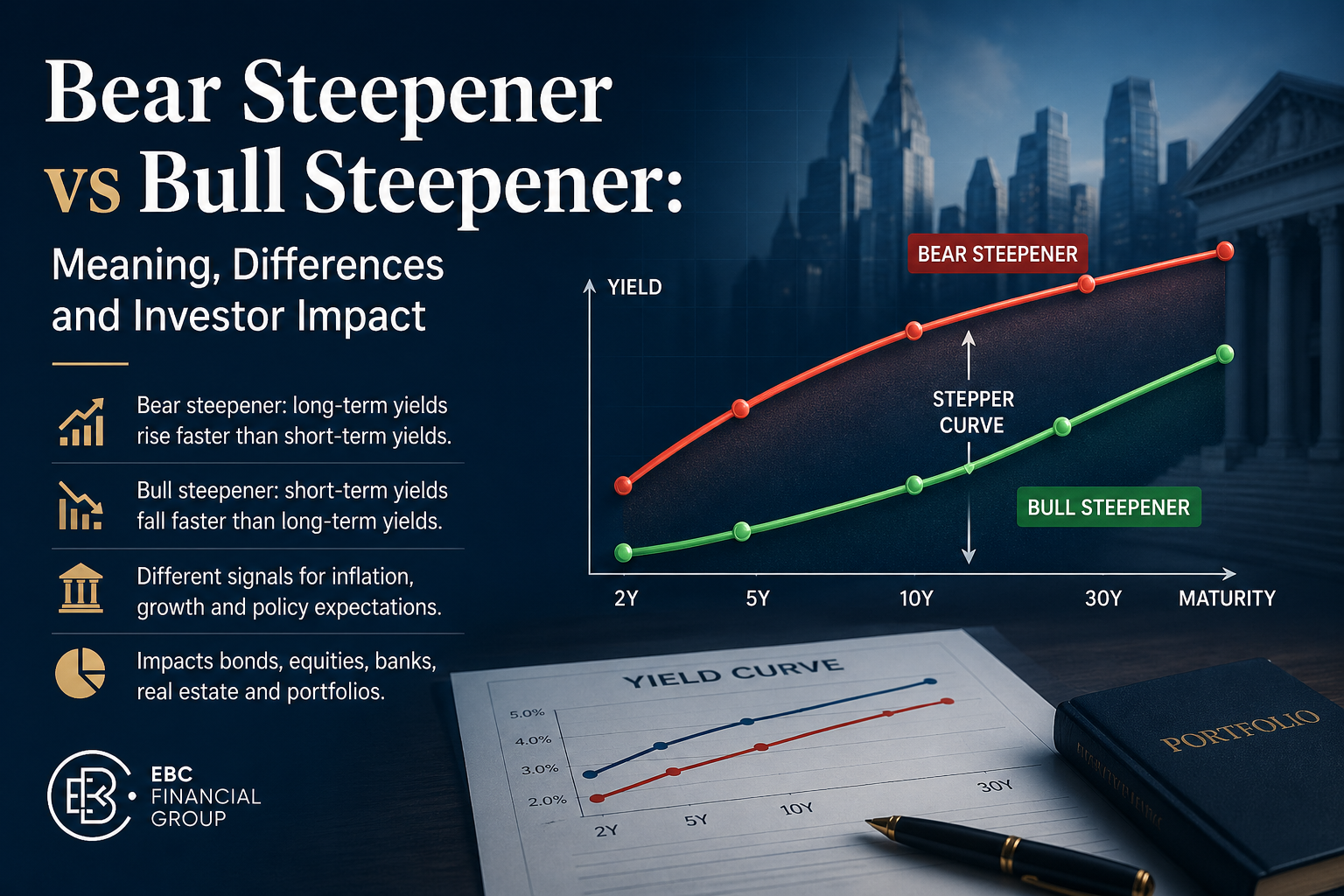
Usually, the curve slopes upward because longer-term bonds pay more than short-term ones. Investors want extra return to tie up their money longer. When the curve inverts, short-term yields rise above long-term yields. This often happens after the Fed raises rates sharply, and markets expect those rates to fall later.
The US yield curve remained inverted for much of 2022 through 2024, but has since returned to a positive slope, with long-term yields once again higher than short-term yields.
As of June 1, 2026, the 2-year US Treasury yield stood at 4.05%, while the 10-year yield was 4.47%, leaving a spread of roughly 42 basis points, or 0.42 percentage points. The 30-year Treasury yield was even higher at 4.99%, indicating that longer-term borrowing costs remain elevated.
Most traders focus on the spread between the 2-year and 10-year yields, but there are other signals as well. For example, some recession models, like the New York Fed's, look at the difference between the 10-year yield and the 3-month Treasury rate.
A positive yield curve doesn't give a simple answer. You still need to figure out if the change is coming from short-term rates, long-term rates, or both.
The 2-year Treasury yield closely follows expectations for Fed policy. When traders start pricing in rate cuts, it usually falls. As it falls, the dollar’s yield advantage over other currencies can narrow.
That means a steeper yield curve driven by lower short-term yields can put pressure on the dollar. If US rates are expected to fall faster than rates elsewhere, some of the dollar’s support may weaken too.
However, the dollar doesn't always move in just one direction.
If the yield curve returns to a more normal shape because the 10-year or 30-year yield is rising, the dollar can hold its ground. Higher long-term yields can still attract investors looking for better returns. Higher long-term yields may reflect worries about inflation, fiscal pressure, or a flood of bond supply, and in such a mood, traders may still reach for the dollar as they cut risk elsewhere.
A practical way to read this is to compare the dollar with the 2-year Treasury yield. If both move in the same direction, markets are likely focused on Fed policy. If the dollar rises while the 2-year yield falls, the move may be more about investors looking for safety than about interest rate expectations.
For traders following how Fed expectations move through currency markets, EBC’s forex products page shows the available FX pairs that can be used to track US dollar strength and weakness across major currencies.
Gold is one of the few assets that does not always move the way you would expect when interest rates rise. Sometimes gold prices can still go up even when yields are increasing.
Gold doesn't pay interest, so when real yields go up, gold looks less attractive. Real yields are bond yields after removing inflation expectations. If you can earn more from an inflation-adjusted bond, there's less reason to hold gold, which doesn't yield anything.
But things don't always work out that simply.
When long-term yields rise because investors are worried about debt, inflation, or policy stability, gold can still move higher. In that case, gold is not just reacting to interest rates. It is reacting to demand for safety.
This is why the 10-year nominal yield is the wrong thing to watch gold against on its own. Pair it with the 10-year real yield.
Some analysts interpret a drop in real yields alongside a rise in gold as a reaction to lower inflation-adjusted returns, but other factors may be at play. If real yields stay high, but gold still rises, there's another reason at play. In that case, the market is likely worried about inflation, debt, or general uncertainty, not just expecting rate cuts.
For US indices, the long end (the 10-year and 30-year) usually matters more than the 2-year.
Investors often use long-term interest rates to judge what future earnings are worth today. When those rates rise, future profits become less valuable in today's terms. Companies that are expected to earn most of their profits many years from now tend to feel the biggest impact.
On Nasdaq, many companies are valued based on future growth, so a higher 10-year yield makes those valuations harder to justify. The S&P 500 covers more companies, but it's not immune. If earnings expectations are strong, the index can handle higher yields for a while, but if those expectations weaken, higher yields become a bigger problem.
The Russell 2000 is affected by a different set of pressures. Smaller companies are usually more exposed to the US economy, borrowing costs, and access to credit.
If the yield curve turns positive because short-term yields are falling and credit markets remain stable, small caps may benefit. But if the curve returns to a normal shape because long-term yields are rising and credit spreads are widening, it can be a warning sign.
Credit spreads are the extra interest companies pay to borrow compared to the US government. When these spreads widen, it usually means investors are more concerned about corporate risk. That's why it's important to watch credit spreads alongside the yield curve. A positive curve with stable spreads means one thing, but a positive curve with widening spreads means the market is getting more worried about growth and refinancing costs.
Emerging market currencies usually perform better when US short-term yields go down.
When short-term US yields fall, the dollar's yield advantage decreases. This gives emerging market currencies a chance to rally, especially if local economies are stable and global investors are willing to take risks.
How much support an emerging market has depends on why the yield curve is returning to a more normal shape.
If the curve turns positive because the Fed is expected to cut rates, it can support emerging markets. But if long-term US yields are rising, money may flow back into the US, creating challenges for emerging market currencies and borrowers.
A curve that steepens because the 2-year yield is falling is easier for emerging markets to handle. But if the curve steepens because the 10-year or 30-year yield is rising, it can still cause problems, even if the Fed is expected to cut rates.
Pay attention to how prices move for confirmation. If emerging market currencies strengthen while the dollar weakens and credit markets remain stable, traders see the curve as a sign that policy will become more relaxed. If those currencies weaken while long-term US yields rise, the market is reacting to fiscal pressure or increased risk aversion.
The yield curve has a long history as a recession warning, and inversions have happened before many US recessions. However, the timing is never exact, a recession doesn't start as soon as the curve inverts, sometimes it only arrives after the curve has already turned positive again.
On its own, a steepening curve does not predict anything, you need to look for more evidence, the warning becomes evident if the curve stays positive while borrowing conditions are becoming tighter, job data weakens and stocks are driving the market higher. That's when investors start worrying less about interest rates and more about the strength of the economy.
The calmer scenario is different. Inflation cools, the labour market slows but stays stable, borrowing conditions remain manageable, and the curve stays positive mainly because short-term yields are moving lower.
If the 2-year yield drops while the 10-year stays steady, the market is expecting Fed rate cuts. This usually puts pressure on the dollar and encourages risk-taking, as long as credit markets remain stable.
If the 10-year and 30-year yields rise while the 2-year stays steady, it signals concerns about inflation, fiscal pressure, or a large supply of Treasuries. This scenario is tougher for growth stocks, emerging market currencies, and highly valued parts of the stock market.
If the curve steepens and credit spreads widen simultaneously, it's best to be cautious. The bond market is then signalling not just easier policy, but real worries about the economy's direction.
And if gold rises while real yields stay high, the move is about protection rather than lower rates, a vote for worry about inflation, debt, or policy credibility.
The return to a positive curve is useful, but it isn't the whole signal. What really matters lies beneath it: is the move being driven by easier Fed expectations, or by investors demanding higher returns to hold long-term US debt? Whichever it is decides how all of this feeds through to the dollar, gold, US indices, and emerging market currencies.
For traders watching how higher long-term yields affect broad equity markets, EBC’s index CFDs page explains how index CFDs can be used to follow major stock-market benchmarks without focusing on a single company.