Published on: 2025-11-03
Updated on: 2026-09-04
The bid-ask spread is the difference between the bid price (the highest price a buyer will pay for an asset) and the ask price (the lowest price a seller will accept). It is a direct trading cost. You buy at the ask, you sell at the bid, and the gap between the two is what the trade costs you at that moment.
A quick example. If EUR/USD shows a bid of 1.10000 and an ask of 1.10012, the spread is 0.00012, or 1.2 pips. A pip is the smallest standard price move in most currency pairs, equal to 0.0001. The narrower the spread, the cheaper it is to enter and exit a position.
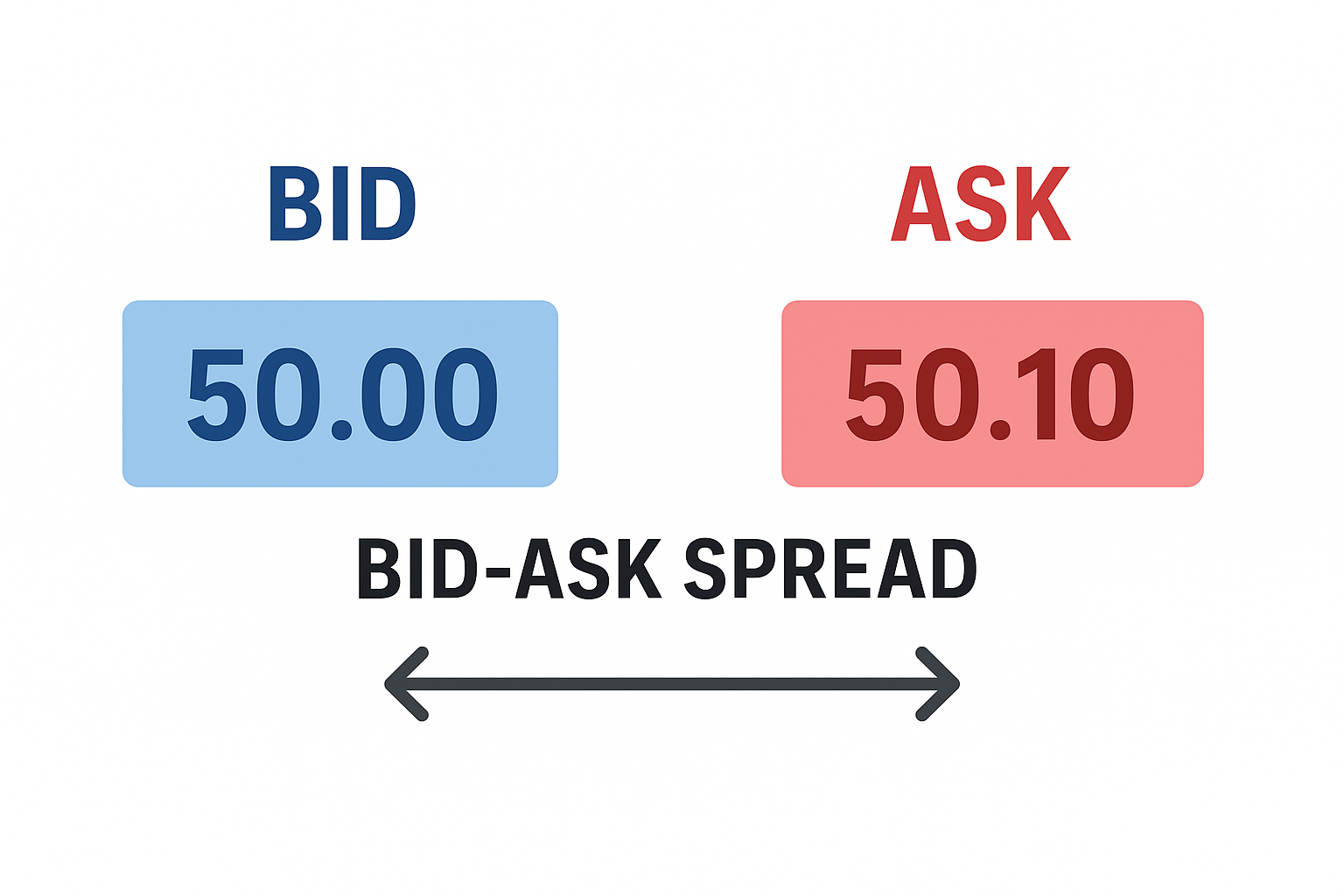
Every tradable asset shows two live prices at the same time.
Bid price: the highest price buyers are currently willing to pay. If you sell right now, you sell at the bid.
Ask price (also called the offer): the lowest price sellers are currently willing to accept. If you buy right now, you buy at the ask.
When a buyer accepts the ask, or a seller accepts the bid, a trade takes place, and fresh quotes replace the old ones. The ask always sits above the bid: whoever quotes both sides must earn something for holding the asset and offering a price on demand, and that reward is the spread. For a side-by-side comparison of the two prices, see bid versus ask in more depth.
The formula:
Bid-ask spread = Ask price − Bid price
To compare assets that trade at different price levels, use the spread percentage:
Spread percentage = (Ask − Bid) ÷ Ask × 100
The percentage matters because the same absolute spread is far more expensive on a 5.00 stock than on a 500.00 stock.
Bid: 1.10000
Ask: 1.10015
Spread = 1.10015 − 1.10000 = 0.00015 = 1.5 pips
Forex spreads are measured in pips. On one standard lot of EUR/USD (100,000 units), one pip is worth about 10 US dollars, so this spread costs about 15 US dollars to open the position. As a percentage: 0.00015 ÷ 1.10015 × 100 = about 0.014%.
Bid: 180.00
Ask: 180.05
Spread = 0.05 per share, or about 0.028%
Buying 200 shares at the ask costs 36,010. Selling them back at the bid returns 36,000. The 10 difference is the spread cost of that buy and sell.
The spread is the payment earned by whoever provides a two-sided quote. A market maker is a firm or dealer that stands ready to buy and sell an asset at the same time, quoting both a bid and an ask. Four costs are built into that quote:
Order-processing cost: the operational cost of quoting, matching, and clearing trades.
Inventory risk: a dealer who buys from you holds the asset and may see its price fall before selling it on.
Adverse selection: the risk that the other side of the trade knows something the dealer does not.
Dealer margin: the remainder, which pays for supplying liquidity on demand.
Liquidity is how easily an asset can be bought or sold without moving its price. Deep liquidity brings more competing quotes and a narrower spread. Thin liquidity means fewer quotes, more risk per quote, and a wider spread.
Spreads change through the day and across instruments. The main drivers:
Liquidity: more active buyers and sellers mean tighter spreads. Major pairs such as EUR/USD, USD/JPY, and GBP/USD carry the tightest structural spreads, while exotic pairs and thinly traded stocks sit at the wide end.
Volatility: when prices move fast, quote providers widen spreads to protect against sudden losses.
Trading session: forex trades 24 hours on weekdays, but liquidity is uneven. Spreads are usually tightest when major sessions overlap and wider in quiet hours.
News events: central bank decisions and major data releases can widen spreads sharply for a few seconds as liquidity thins.
Market depth explains why major pairs stay tight. According to the Bank for International Settlements, over-the-counter foreign exchange trading averaged 9.6 trillion US dollars per day in April 2025 (BIS Triennial Central Bank Survey, September 30, 2025). That turnover is why heavily traded dollar pairs usually quote the narrowest spreads.
Spreads are quoted in two ways.
Feature |
Fixed spread |
Variable (floating) spread |
Size |
Constant in all conditions |
Moves with liquidity and volatility |
Calm markets |
Unchanged |
Often very tight |
Volatile markets |
Unchanged |
Can widen quickly |
Known in advance |
Yes, the exact cost |
Only the current level |
A fixed spread gives cost certainty. A variable spread can be smaller in calm, liquid markets but wider around news.
No. The spread is built into the price itself, so you pay it the moment a trade opens, even if no separate fee appears on your statement. A commission is an explicit charge listed on its own line. Some accounts price trades mainly through the spread. Others quote a tighter spread and add a commission per lot or per share. The full cost of a trade is the spread plus any commission, so comparing one number without the other understates the cost.
The spread is where your order meets the market, so it connects directly to how order types and execution work.
A market order crosses the spread: a buy fills at the ask, a sell fills at the bid. You pay the spread for immediate execution.
A limit order waits at your chosen price, on or inside the spread. It may fill at a better price, or it may not fill at all.
Slippage is a separate cost: the gap between the price you expected and the price you received. Wide spreads and slippage often appear together, because both come from thin liquidity.
Subtract the bid price from the ask price. For a comparable figure across assets, divide that difference by the ask price and multiply by 100 to get the spread percentage.
A market buy order fills at the ask, the higher price. A market sell order fills at the bid, the lower price. The gap between them is the cost of trading right away.
Spreads widen when liquidity is low or volatility is high, for example, during major news releases or quiet trading hours, because quote providers demand more compensation for the extra risk.
A narrow spread means the bid and ask are close together. It signals an active, liquid market and a lower cost to enter and exit a position.
The concept is identical. Forex spreads are quoted in pips, while stock spreads are quoted in the share’s currency. Major pairs usually show the tightest spreads because their markets are the most liquid.
A narrow spread signals deep, active quoting. A wide one signals a thin or nervous market. The spread you see during a calm session on a major pair can look very different seconds after a central bank announcement, even though the instrument has not changed. Checking the current spread and how it is behaving turns a hidden cost into visible information before you commit to a trade. You can trade forex across major and minor currency pairs once you understand how that cost moves.
Disclaimer: This material is for general information purposes only and is not intended as (and should not be considered to be) financial, investment or other advice on which reliance should be placed. No opinion given in the material constitutes a recommendation by EBC or the author that any particular investment, security, transaction or investment strategy is suitable for any specific person.



World's Best Broker